
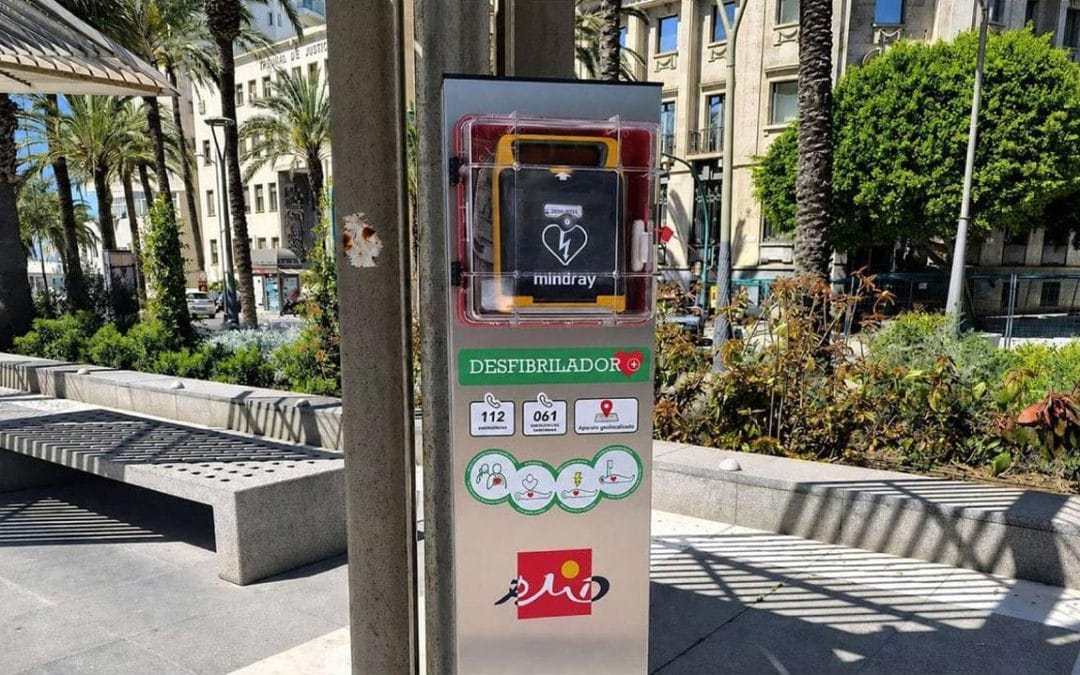
The Almería City Council has installed the first five totems with automated external defibrillators in public spaces, as part of the plan Almería Capital Heart Safe. According to information published by the City Council itself, these first devices are located in Plaza Marín, Avenida Federico García Lorca, and Paseo Marítimo, and are designed to be accessible 24 hours a day with clear signage and assisted use even for non-medical personnel.
The news, honestly, seems very positive to me.
It is something we should value that a city moves towards safer public spaces, better prepared and with resources available in case of an emergency. In the event of cardiac arrest, every minute counts, and having a defibrillator nearby can make a huge difference.
But upon reading the news, a very simple question arose for me:
We have defibrillators available, but are we really prepared to know when to use them?
Having the device is important. Knowing how to act is also important.
An automated external defibrillator can be a decisive tool in an emergency. But the reality is that many people, even if they have one in front of them, can freeze up.
And not for lack of trying.
On the contrary: most people want to help.
The problem is something else.
The problem is fear.
Fear of making mistakes.
Fear of causing harm.
Fear of using the defibrillator when it's not appropriate.
Fear of not knowing if the person is truly in cardiac arrest.
Fear that everything depends on us.
That's why, along with installing defibrillators, I think there's an equally important conversation: Civic Education.
Because it's not enough for the device to be in the street. We also need people to know how to recognize an emergency, call 112, stay calm, and follow basic guidelines until emergency services arrive.
The question is not just “where is the defibrillator”
For a long time, when talking about heart-safe cities, the conversation focused on the location of defibrillators.
Where are they.
How many are there.
If they are visible.
If they are accessible.
They operate 24 hours a day.
All of that is fundamental.
But there's another question we shouldn't leave out:
What happens in the first few minutes before the ambulance arrives?
Because an emergency doesn't start when the medical team arrives. It starts before.
It starts when someone collapses.
When a person stops responding.
When someone is breathing strangely.
When those around don't know whether to approach, call, wait, or act.
And in those first few minutes, the difference often isn't just made by technology. It's made by preparation.
The defibrillator helps, but it does not eliminate the blockage.
One of the advantages of automated external defibrillators is that they are designed to guide the person using them. The European Resuscitation Council guidelines indicate that when the AED is available, it should be turned on, the pads applied, and the visual or voice instructions of the device itself followed. They also state that AEDs can be safely used by bystanders and first responders.
This is important to say, because many people think using a defibrillator is something extremely technical.
But even so, there's a prior barrier: Dare to take the step.
And that's where training comes in.
An educated person doesn't have to know everything. They don't have to become a healthcare professional. They don't have to diagnose like a doctor.
But it can know something essential:
- How to assess if someone is responding;
- how to ask for help correctly;
- how to explain the situation to 112;
- How to recognize warning signs;
- How to start a basic performance;
- How to follow a defibrillator's instructions;
- and, above all, how not to be paralyzed.
Every minute counts, but most of us never practice.
The City Council itself recalls in its statement that in Spain there are around 30,000 out-of-hospital cardiac arrests per year and that every minute without CPR or defibrillation reduces the chances of survival by about 10%.
That data is impressive.
But it should also make us think.
Because if every minute counts, then the first answer matters a lot.
And that first response is almost never given by a healthcare professional. It's usually given by someone nearby: a family member, a coworker, a passerby, someone in an office, a store, a training room, or a public space.
That's why it seems so important to me that defibrillators be installed, but also that we talk more about first aid and practical training.
Not from fear.
From responsibility.
A heart-safe city needs prepared citizens
Almería takes an important step by installing these first defibrillator totems. And hopefully, the network will continue to grow in more neighborhoods, streets, squares, sports centers, public spaces, and high-traffic areas.
But a truly cardiac-safe city is more than just a city with devices.
It's a city where more people know how to act.
Where calling 112 does not cause a lockdown.
Where it is understood when a defibrillator may be needed.
Where the fear of getting closer is lost.
Where is learning basic CPR normalized?.
Where companies, associations, educational centers, and workspaces are also involved.
Because security doesn't just depend on institutions. It also depends on the culture we build together.
That's why it makes sense to train
This news seems like a perfect opportunity to remind ourselves of something important: First aid should be part of our basic training as citizens..
Just as we learn to drive, use digital tools, or navigate the workplace, we should also learn how to act in an emergency.
Not because we think it's going to happen to us tomorrow.
Because, if it happens in front of us one day, it will be better to be prepared.
From Workspace Coworking Almería, we want to do our part by organizing an in-person first aid training session, designed to teach clearly, practically, and simply what to do in those crucial first minutes before professional help arrives.
Training to overcome fear, gain judgment, and act with greater confidence.
Why having defibrillators in the city is great news.
But knowing when and how to act can be what truly makes the difference.
Technology saves lives. Training does too.
Installing defibrillators is moving forward.
Training people is completing the journey.
That's why, rather than just sticking with the good news that Almería has new cardioprotected totems, we should take this moment to ask ourselves an uncomfortable but necessary question:
If tomorrow someone collapses in front of me, would I know what to do until the ambulance arrives?
If the answer is “I'm not sure”, that's okay.
That's precisely why you need to get trained.
Because an emergency doesn't wait for us to be prepared.
But we can prepare beforehand.
Recommended CTA
Do you want to learn how to act more confidently in an emergency?
At Workspace Coworking Almería, we organize a In-person first aid training, where we will learn in a practical way how to respond in those important first minutes: how to stay calm, when to call 112, how to act in a critical situation, and how to understand the basic use of a defibrillator.
Hello! I'm Cristiano Gomes 👋
I'm doing my internship at Workspace, learning every day and enjoying an environment where working and growing is much easier. I try to live this stage with enthusiasm, commitment, and a service-oriented attitude towards others. 💪✨
