
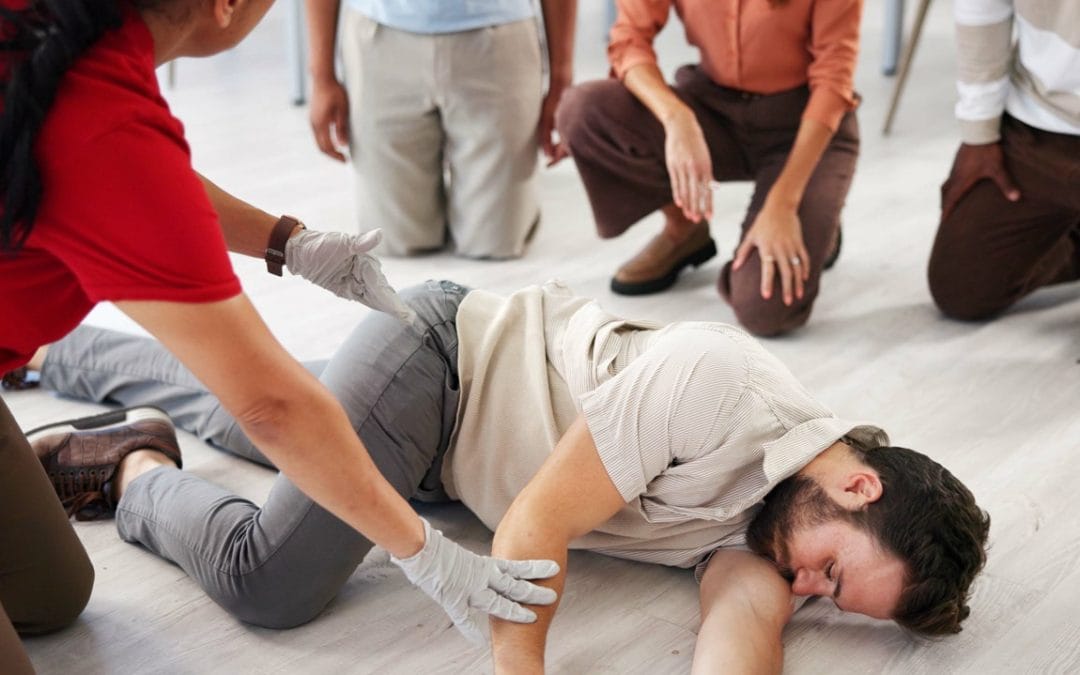
There are questions that don't come up every day, but when they do, they stay with you.
It's been happening to me for years with a specific one: What would I do if one day I found myself in an emergency and someone needed my help? I'm not talking about an extraordinary or distant situation. I'm talking about something much more everyday and, precisely because of that, more real: a friend collapsing, a family member who stops responding, a stranger suffering a serious problem in front of you.
And then the second question appears, the real one: Would he / she / they be trained to act?
Most of us want to believe so. That we would react. That we would help. That we would know what to do. But when you consider it honestly, the answer isn't always so comfortable. Because wanting to help isn't the same as knowing how to help.
The difference between being present and being prepared
In an emergency, seconds count. Not just because of what's happening, but because of what's going on inside: nerves, fear, doubt, paralysis. Often, the desire to intervene doesn't fail. What fails is the confidence to do so with sound judgment.
And that's a thought I've been having for a while.
For years, I've thought that there's knowledge that should be part of any adult's basic preparation. Not because we live waiting for an emergency, but because real life doesn't give notice. Unexpected situations happen. And when they do, there isn't always time to improvise.
That's why I'm increasingly convinced that knowing how to act in an emergency shouldn't be seen as optional or reserved for certain professionals. It should be understood as a form of personal and collective responsibility.
When helping isn't enough if you don't know how to do it
We all believe that, when the time comes, we would do whatever it takes to help. But in tense situations, good intentions alone don't solve anything. In fact, many people don't act not out of a lack of willingness, but out of fear of doing it wrong.
The problem isn't not wanting to help
The problem is not having a minimum foundation to react with serenity.
Knowing how to identify that something serious is happening. Knowing how to ask for help correctly. Knowing how to stay calm. Knowing what to do while professionals arrive. Those kinds of skills don't make you a healthcare professional, but they do put you in a very different position when faced with a critical situation.
And that difference matters.
Because experiencing an emergency feeling like you have no idea how to react is not the same as facing it with training that allows you to act with a bit more security, order, and confidence.
The peace of mind of knowing you wouldn't be starting from scratch
Perhaps that's the true value of this type of learning. Not so much the isolated technique, but the peace of mind of not completely blanking if one day you have to live something like that up close.
It's not about living in fear. It's about living with a little more preparation.
Why does this reflection seem so important to me?
Sometimes we postpone certain things because they don't seem urgent. We leave them for later. We think we'll learn them someday. That it would be nice to know, yes, but that it's not the right time right now.
I've thought of that many times too.
But over time, I've come to a fairly simple conclusion: There are things it's better to learn before you need them. And this is one of them.
Not because we have to become experts. Not because we will face an emergency tomorrow. But because, if it ever happens, we will be grateful we didn't start from scratch.
Learn by prevention, not by dramatics.
That nuance seems important to me.
Talking about emergency training should not be approached with fear or drama. It should focus on prevention, responsibility, and peace of mind. Just as we learn other skills to better navigate life, it also makes sense to acquire tools that help us respond to situations no one wants to experience, but that can happen.
And when you look at it that way, it stops seeming like “extra” knowledge and starts seeming quite logical.
Useful, real, and meaningful learning
There are courses you take for your resume. Others out of obligation. And then there are those that have a much more direct value: those that can help you perform better in real life.
This type of learning falls into that category.
That's why I find it interesting to open this conversation and approach it with an honest question, not a lesson: If one day someone needed your help, would you feel truly prepared to act?
There's no need to answer it quickly. In fact, perhaps the important thing isn't to answer it, but to let it do its work.
Because when a question makes you a little uncomfortable, it's usually because it touches on something important.
Learning is also a way of taking care of oneself
Sometimes we think of care only in emotional, familial, or professional terms. But care is also this: deciding it's worth being a little more prepared in case one day someone close to you needs you to react.
A friend. A relative. A colleague. Or someone you don't know at all.
In the end, we never know when such a situation might cross our path. What we can decide is whether we want to keep postponing that preparation for “some day”... or take a step to feel more capable, more at ease, and more useful if the moment arrives.
At Workspace Coworking Almeria We like the space to be useful for more than just work: also for sharing useful, practical learnings connected to real life.
An opportunity to stop thinking about it and start learning
There are reflections that are good. But there are times when it's worth turning reflection into action.
If you've ever asked yourself this question too, perhaps this is a good opportunity to take that step and acquire knowledge that, although hopefully you'll never have to put into practice, can make a huge difference if the time ever comes.
Final CTA
If you want to stop asking yourself “would I know what to do?” and start feeling more prepared for an emergency situation, you can get information below.
Hello! I'm Cristiano Gomes 👋
I'm doing my internship at Workspace, learning every day and enjoying an environment where working and growing is much easier. I try to live this stage with enthusiasm, commitment, and a service-oriented attitude towards others. 💪✨
